Your best waybecomes the way.

You rolled out AI. A few people built prompts that save them real time. Most are still typing from scratch. Worktype turns the ones that are working into the standard for everyone doing that type of work.

Seven days free · No card · Set up in an afternoon
Works with

Copilot  ·  ChatGPT  ·  Claude  ·  Gemini

Whatever your people already open, including all four at once. The standard lives in Worktype, so changing assistants later doesn't mean establishing it again from scratch.
Where you are now

Everyone writes their own

The prompt that actually works exists. It's on one laptop, and nobody outside that person's team will ever see it.

Quality is a lotteryIt depends entirely on who picks up the task, and nothing tells you what you're getting
Only a few people shareThe enthusiasts contribute. Everyone else never will, because it's work with no payoff for them
Nothing to show for itYou can report logins. You can't say whether anything is done better than it was in January

Where Worktype puts you

Everyone works from one

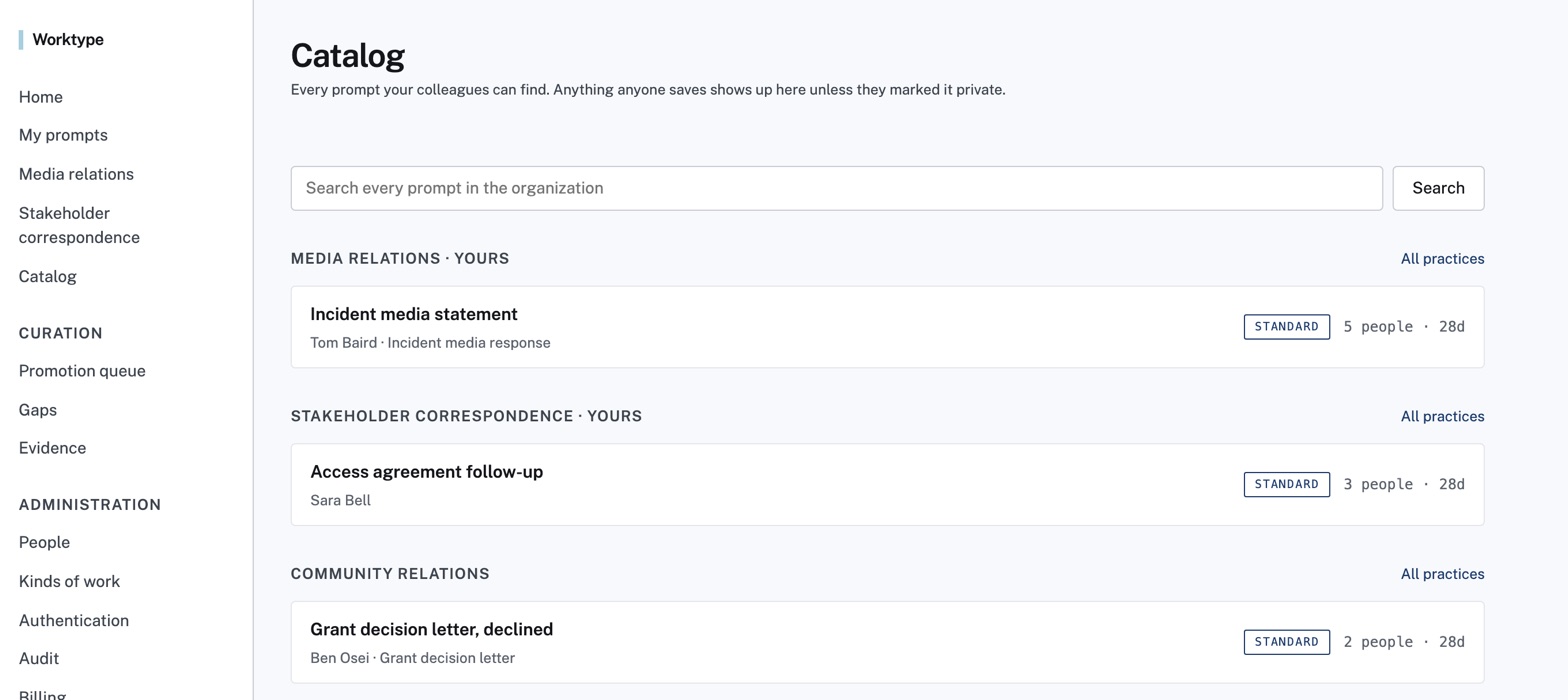
People save prompts for themselves. When colleagues keep using one, Worktype surfaces it. You promote it, and everyone doing that type of work has it.

Quality has a signalWhat people who didn't write it keep coming back to
Sharing is a byproductSaving for yourself is the contribution. Nobody has to write anything up for anyone
Something to showDated, named, exportable, straight into the deck you already have to write

How it works

Only one step needs anyone to change what they do.

Programs like this die where they ask busy people to contribute. Worktype never asks. The only thing anyone has to do is save a prompt they wanted for themselves anyway.

First

Someone saves a prompt

Because they'll want it again next week. It stays private and it stays theirs. This is the only behavior you ever have to encourage.

Then

Three other people copy it

Not three views. Three people who didn't write it, taking it away to use. That threshold is what puts it in your queue, so nothing arrives because someone lobbied for it.

Finally

You make it the standard

Replace the author's specifics with variables so it fits everyone, then promote it. Everyone doing that type of work gets it, and the original stays with the person who wrote it.

Worktype never watches what anyone types. It records two deliberate actions and nothing else: saving a prompt, and copying one. No keystrokes, no page content, no clipboard monitoring.

Who it reaches

Same work. Different bosses.

Almost any job worth standardizing is done in more than one department. Every tool built for this sends things to teams, so it reaches whoever shares a manager instead of whoever does the work.

Sent to a team

Mostly the wrong people.

It lands with everyone who shares a manager. Seven of them will never open it, and the people who actually do the job mostly sit somewhere else.

The account team
9 reached. 2 do this work.

Sent to a kind of work

Exactly the right people.

It lands with everyone who does that job, wherever they sit. We call that a work type: a kind of work, not a box on the org chart.

Account managersCustomer successRenewalsSupport leadsSolutions engineers
41 reached across 5 teams. All 41 do this work.

What you get

Built to move prompts, not store them.

Storage was never the hard part. Each of these exists to move a prompt that's working from the one person who wrote it to everyone doing the same job, and to prove it moved. All of it comes with every tier, from the first day of the trial.

Nobody has to contribute

The queue

When three people copy a prompt they didn't write, it lands in your review queue automatically. That is the entire pipeline: nobody is asked to share, submit, or write anything up, and every decision is reversible, on the record.

One version fits everyone

Fill-in blanks

Before you send a prompt out to everyone, its specifics become blanks: the client, the product, the deadline. Each person fills in their own, so one prompt serves fifty people instead of fifty near-copies drifting apart.

No new habits to learn

The extension

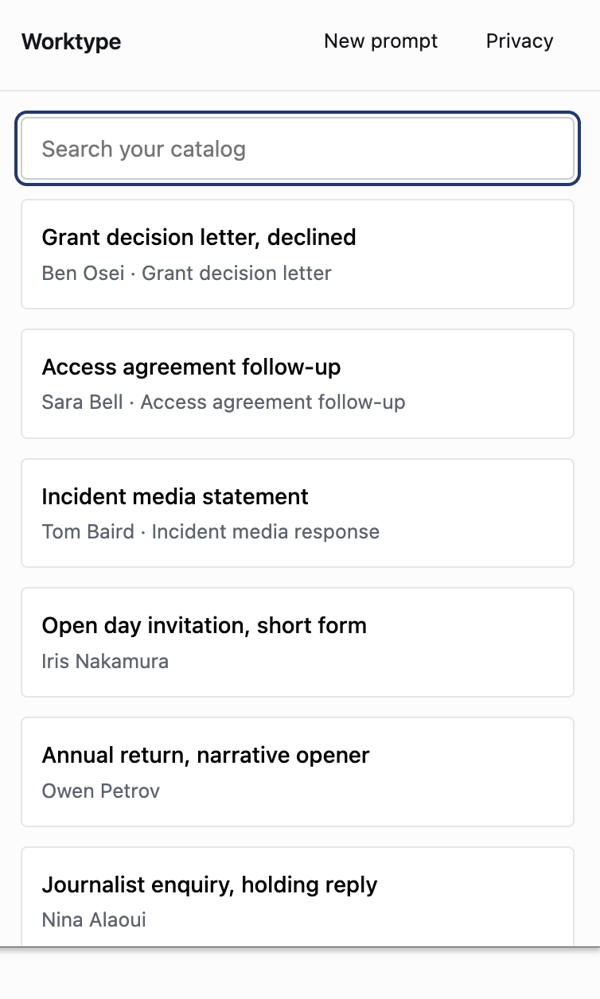
People save and reuse prompts from a small add-on in Edge and Chrome, in the tab where they already work. No separate app and nothing to remember, so using it never depends on anyone changing how they work.

Proof it's catching on

Four measures

Which prompts get reused, whether they spread beyond the group that wrote them, how many people are adding new ones, and which jobs still have no standard at all. Every number counts real people on real dates, never views or logins.

For the leadership deck

Dated exports

Every number exports as a CSV or a dated image with the underlying counts attached, so when someone in the room asks where a figure came from, you can show them.

One less thing for IT

Single sign-on

Microsoft Entra ID sign-on comes with every tier. People use the work account they already have, IT reviews one integration, and nobody manages another password.

Pricing

Start on your own card.

Seven days free, no card. You shouldn't need a procurement cycle to find out whether this works.

Team

$250$200a month

Up to 100 people. One team, or the pilot group you start with.

Billed monthly

$2,400 billed annually

Start free

Division

$950$760a month

Up to 750 people. A department or a business unit.

Billed monthly

$9,120 billed annually

Start free

Company

$2,500$2,000a month

Up to 5,000 people. The whole organization.

Billed monthly

$24,000 billed annually

Start free

Every tier is the whole product: unlimited kinds of work, unlimited prompts, no seat count. The band is set by your headcount, so rolling it out to more people never costs more. See full pricing.

Pick one thing everyone does.

Set it up this afternoon and seed it with one prompt someone already wrote. Ask three colleagues to use it, and you will have watched the whole loop run before the week is out.

Seven days free · No card · Works with any assistant